Who is your favorite historical figure?
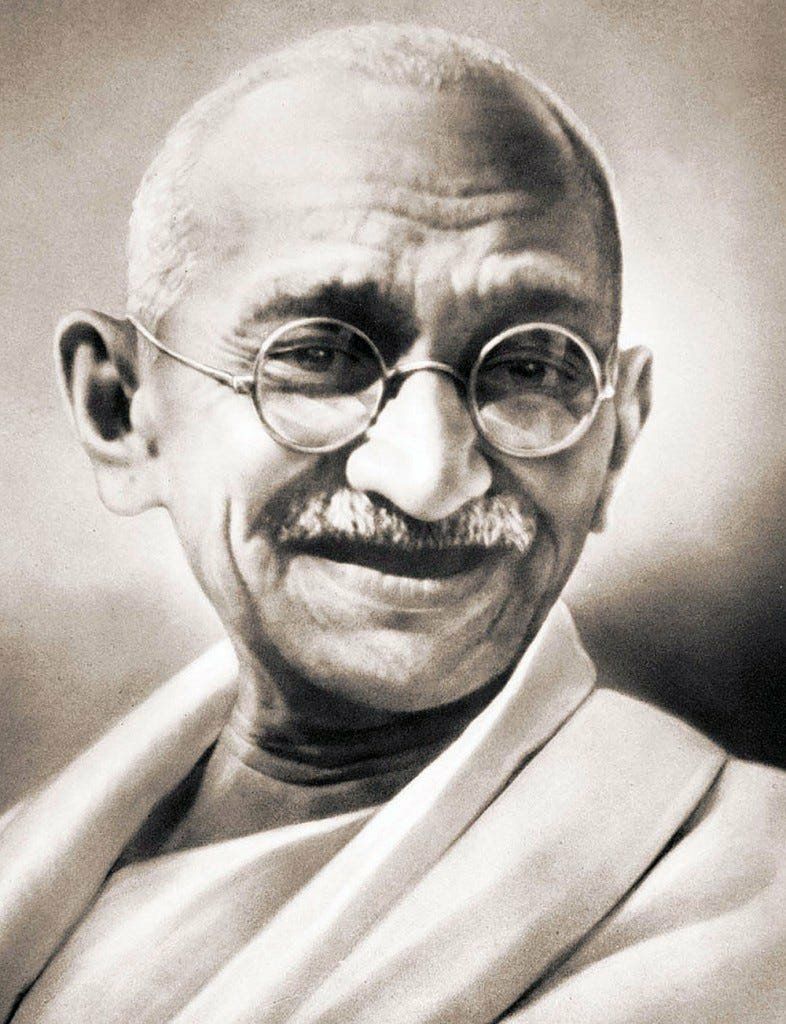
Gandhi ji inspired movements for civil rights and freedom across the world. He is also one of the rare leaders from India in whose name over 100 countries are expected to release commemorative stamps.
The base of Gandhian philosophy is the spiritual or religious component. He was a firm believer in God.
He was also a believer in humanity.
He believed that human nature is good. He considered all people are capable of moral development.
Gandhian Philosophies are as follows
1. Truth and Non violence- Mahatma Gandhi focuses on living a philosophy of satya (truth) and ahimsa (nonviolence). Gandhi’s primary concern is with developing moral character and practice and with ethics as first philosophy.
2. Satyagraha, the concept was introduced in the early 20th century by Mahatma Gandhi and designated a determined but nonviolent resistance to evil. The supreme idea of truth naturally leads to the Gandhian ideology of Satyagraha. Protecting the standards and tenets of truth is essential if it is the ultimate reality. God, who is the utmost truth and reality, requires a votary who is completely compassionate and unselfish.
3. Sarvodaya is a term meaning ‘universal uplift’ or ‘progress of all’. It was coined by Gandhi in 1908 as a title for his translation of John Ruskin’s Unto This Last. The Sarvodaya Movement has as its target the establishment of a whole network of such self-supporting village communities.
4. Swadeshi, which means “of one’s own country,” can be loosely translated as “self-sufficiency” in most settings. Gandhiji asserts that the Charkha has the distinction of being able to address the issue of economic distress in a way that is most logical, straightforward, affordable, and professional. It stands for both the wealth and freedom of the country. It represents commercial peace rather than commercial strife.
5. Trusteeship is a key component of Gandhian economics that could be called the nonviolent equivalent of ownership. The idea was taken from English law by Gandhi. It denotes that one is a trustee rather than the owner of their belongings, including eventually their skills or abilities.
He professed the philosophy of Hindu Universalism (also see Universalism), which maintains that all religions contain truth and therefore worthy of toleration and respect. It was articulated by Gandhi:
“After long study and experience, I have come to the conclusion that all religions are true all religions have some error in them; all religions are almost as dear to me as my own Hinduism, in as much as all human beings should be as dear to one as one’s own close relatives. My own veneration for other faiths is the same as that for my own faith; therefore no thought of conversion is possible.”
Gandhi believed that at the core of every religion was truth (satya), non-violence (ahimsa) and the Golden Rule.
Gandhi’s ideas on governance. Gandhi’s utopian “Ramrajya”, his perfect state, was different. It didn’t require a constitution, an elected government, a military or a constabulary.
The system of capitalism, Communist rule, abuse, and religious violence wouldn’t exist. Instead, the nation was to be fashioned after ancient India. The philosophy of Mahatma Gandhi advocates for a traditional, moral, and apolitical state. Swaraj emphasizes the need to foster individual and collective self-governance. Swaraj is linked to the capacity for aim self-evaluation, ongoing self-purification, and increasing self-reliance at the individual level.

 Rang-Rivaz
Thank you for the post, I learned a few things I did not know.
LikeLiked by 1 person
Thank you so much for appreciation 🙏🥰
LikeLike
Few of this generation have understood him, yet his greatness can never be diminished
LikeLiked by 1 person
Sure sir, because of whatsapp university!!😜
LikeLiked by 1 person
Thank you so much for appreciation 🙏
LikeLiked by 1 person
Originally from my state Gujarat
LikeLiked by 1 person
And inspiration for the whole world even today.
LikeLike